
Magnifica Humanitas and AI
Why the Future Needs Humans at the Helm

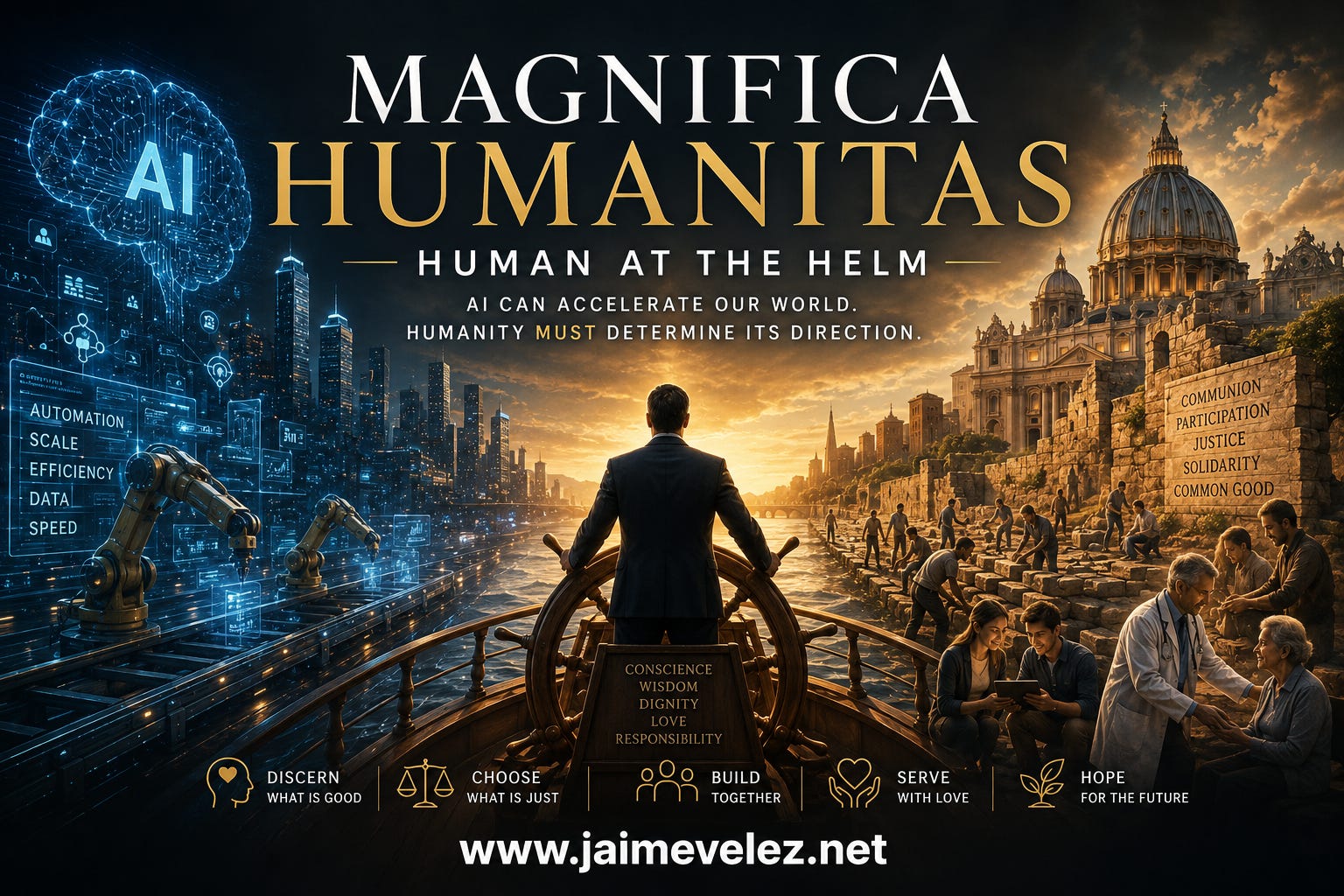
Most people are still trying to understand AI by placing it inside a familiar category.
We call it a chatbot. We call it a tool. We call it software. We are even calling it Agents.
We describe it as something that can help us write emails faster, summarize long documents, create images, draft meeting notes, write poetry for our loved ones, or my favorite use case: roast my fantasy football friends after a sweet defeat.
AI is not just another application sitting on the digital shelf, waiting for us to open it when we need a quick productivity boost. It is becoming part of the environment we live and work in. It is moving into our search engines, our phones, our workplaces, our schools, our healthcare systems, our creative tools, our financial systems, and eventually into many of the decisions that shape everyday life.
That does not mean AI will change everything. I try to be careful with that kind of language because it usually leads to either hype or fear. But I do believe AI will change many things that matter. It will change how we work. It will change how we learn. It will change how organizations make decisions. It will change how information is created, trusted, questioned, and shared.
And because of that, we need to talk about more than just use cases.
We need to talk about what kind of human beings we want to become while using these tools.
That is the part I keep coming back to. It’s my mission for this Substack publication: to help us all Make Work Human.
Because the more capable AI becomes, the more important it becomes for us to protect the parts of life that should never be automated away. Our conscience. Our judgment. Our dignity. Our relationships. Our responsibility to one another. Our ability to love, forgive, hope, pray, discern, and choose what is good even when the easier path is available.
AI may help us move faster.
But speed is not the same as wisdom.
And if we are not careful, we may wake up one day and realize we did not lose our humanity because machines took it from us. We surrendered it slowly, one convenient shortcut at a time.
That is why Pope Leo XIV’s encyclical Magnifica Humanitas, focused on safeguarding the human person in the time of artificial intelligence, feels so timely.
I have been writing about this for a while. In June 2025, I published a piece called What is Meaningful Work, Anyway? where I wrote about Pope Leo XIV’s early warnings, his deliberate choice to invoke Leo XIII, and the link back to Rerum Novarum. Reading Magnifica Humanitas now feels less like a surprise and more like a confirmation. The encyclical formalizes what many of us have been sensing for a year.
It is not a panic document. It is not a rejection of technology. It is not a theological version of “delete your apps and go live in the woods.” The Pope acknowledges that technology has always been part of the human story and has often improved human life. But he also warns that today’s digital technologies, especially AI, are now woven into decision-making, culture, institutions, power, and imagination in ways we do not fully understand yet.
That is exactly why we need to slow down long enough to ask better questions.
Not just, “What can AI do?”
But:
What should AI do?
Who decides?
Who benefits?
Who is harmed?
What kind of world are we building?
What kind of people are we becoming while we build it?
That is where Magnifica Humanitas and my concept of Human at the Helm meet.
The Pope Is Not Saying AI Is the Enemy
One of the most important things about Magnifica Humanitas is its balance.
The Pope is not saying technology is evil. He is not saying AI should be feared simply because it is powerful. In fact, he recognizes that technology can heal, connect, educate, and protect. But he also reminds us that technology is never neutral in practice because it reflects the intentions, incentives, assumptions, and power structures of the people who design, finance, regulate, and use it.
AI does not arrive in the world as pure magic. It arrives inside business models, political systems, workplace cultures, data structures, economic incentives, and human ambitions.
It can help a doctor make a better diagnosis.
It can help a student learn faster.
It can help a small business owner compete.
It can help a tired knowledge worker reclaim time.
But it can also amplify surveillance, bias, manipulation, inequality, and dehumanizing efficiency.
The tool may be artificial.
The consequences are very human.
That is why the real question is not whether AI is good or bad. That is too simple. The real question is whether we are building AI systems that serve human dignity or systems that quietly train us to serve them.
And yes, that is where the coffee gets strong. So lean in.
Babel or Jerusalem
One of the most powerful images in the encyclical is the Pope’s comparison between the Tower of Babel and the rebuilding of Jerusalem under Nehemiah.
Babel represents human ambition without humility. It is the desire to build something impressive, powerful, centralized, and self-sufficient. It is technology used to “make a name” for ourselves. It is progress without communion. Efficiency without dignity. Scale without soul.
Jerusalem, through the image of Nehemiah, represents something different. Before Nehemiah acts, he prays. He observes. He listens. He does not impose solutions from above. He coordinates the rebuilding of the wall through shared responsibility. Everyone has a section. Everyone plays a part. The city is rebuilt not just with stones, but with trust, participation, and purpose.
That contrast is stunning when applied to AI.
Because AI can help us build Babel.
We can use it to automate bad workflows.
Accelerate shallow decisions.
Optimize people out of processes.
Centralize power.
Turn human beings into data points.
Create systems where nobody knows who is accountable anymore.
Or AI can help us rebuild Jerusalem.
We can use it to remove drudgery.
Improve access to knowledge.
Support better decisions.
Help people do more meaningful work.
Strengthen human creativity.
Make institutions more responsive.
Give people more time for what matters.
Same technology.
Different spirit.
Different helm.
Human at the Helm
For a long time, I have felt that the phrase “human in the loop” is not enough.
It sounds responsible at first. But too often, it means a human gets inserted late in the process to approve, reject, or clean up what the machine already decided. The human becomes a checkpoint. A compliance sticker. A ceremonial rubber stamp.
That is not enough for the age we are entering.
We do not need humans merely in the loop.
We need humans at the helm.
To me, Human at the Helm means humans remain responsible for direction, context, judgment, accountability, and meaning.
AI can assist.
AI can recommend.
AI can generate.
AI can summarize.
AI can automate.
AI can detect patterns we might miss.
But humans must decide what matters.
Humans must define the mission.
Humans must inspect the assumptions.
Humans must understand the consequences.
Humans must own the decision.
Humans must protect the dignity of the people affected.
That is where Magnifica Humanitas gives this idea moral depth. Pope Leo XIV is not just calling for better AI governance. He is calling for a deeper human governance of technological power.
He is asking us to remember that progress cannot be measured only by speed, scale, profit, or productivity. True progress must be measured by whether people become more fully human.
That is the line we cannot cross.
AI Is Not Just a Productivity Question
In business circles, we often talk about AI through the lens of productivity.
How much time can we save?
How many tasks can we automate?
How many employees can do more with less?
How much faster can we ship?
Those are valid questions. I ask them too inside the company I work for.
But they are not the deepest questions.
The deeper question is this:
Are we using AI to make work more human, or are we using AI to make humans more machine-like?
That is where organizations need to be careful.
If AI simply helps us produce more noise, attend more meetings, answer more messages, review more dashboards, and chase more metrics, then we have not created a better future of work. We have just given the hamster wheel a turbo button.
But if AI helps people focus on better judgment, deeper creativity, stronger relationships, clearer thinking, and more meaningful contribution, then we are moving in the right direction.
This is why I believe the next era of work will not belong only to the people who know how to use AI tools.
It will belong to the people who know how to stay human while using them.
The Danger of the Technocratic Mindset
One of the strongest warnings in Magnifica Humanitas is against what the Church has often called the technocratic paradigm. That is the mindset that sees every problem as a technical problem, every person as a unit of productivity, and every solution as something that can be optimized through systems, data, and control.
This mindset is tempting because it feels clean.
Humans are messy.
Data feels clean.
Dashboards feel clean.
Automation feels clean.
Efficiency feels clean.
But life is not clean.
People carry grief, hope, fear, faith, family pressure, health challenges, dreams, wounds, and stories that do not fit neatly into a spreadsheet.
AI can process data, but it cannot fully understand the mystery of a person.
It can predict behavior, but it cannot honor the sacredness of a human life.
It can simulate empathy, but it cannot love.
And that matters.
Especially when AI begins touching areas like hiring, healthcare, education, credit, criminal justice, cybersecurity, and public services.
The more consequential the decision, the more human responsibility matters.
Human Judgment Is Not a Bottleneck
In many organizations, human judgment is treated as friction.
The machine can move faster.
The workflow can be automated.
The approval can be streamlined.
The process can be optimized.
But sometimes friction is not failure.
Sometimes friction is wisdom.
A pause can protect someone.
A question can reveal a bad assumption.
A human review can catch what the system missed.
A moment of discernment can prevent harm.
Human judgment is not always a bottleneck. Sometimes it is the guardrail that keeps the whole system from driving off the cliff while proudly announcing improved throughput.
This does not mean we should resist automation. It means we should automate with discernment.
Before we put AI into the workflow, humans need to take the helm.
What outcome are we pursuing?
What human value are we protecting?
What risk are we introducing?
What decision rights must remain human?
What happens when the system is wrong?
Who has the authority to challenge it?
Who is accountable?
These are not side questions.
These are the questions.
Work Must Remain Human
The Pope also speaks to the dignity of work in a time of digital transition. That is one of the most important parts of the AI conversation.
Because the future of AI is not just about tools. It is about people’s livelihoods, identities, skills, and sense of contribution.
Work is not only how we earn money. For many people, work is how they serve, grow, build, contribute, and participate in society.
As I’ve said many times before. If AI removes the worst parts of work, that can be a blessing.
Let it reduce drudgery.
Let it help with repetitive tasks.
Let it summarize the meeting that should have been an email.
Let it help people spend less time formatting slides and more time thinking clearly.
But if AI becomes a way to quietly devalue people, strip away agency, and reduce human contribution to whatever cannot yet be automated, then we are building the wrong future.
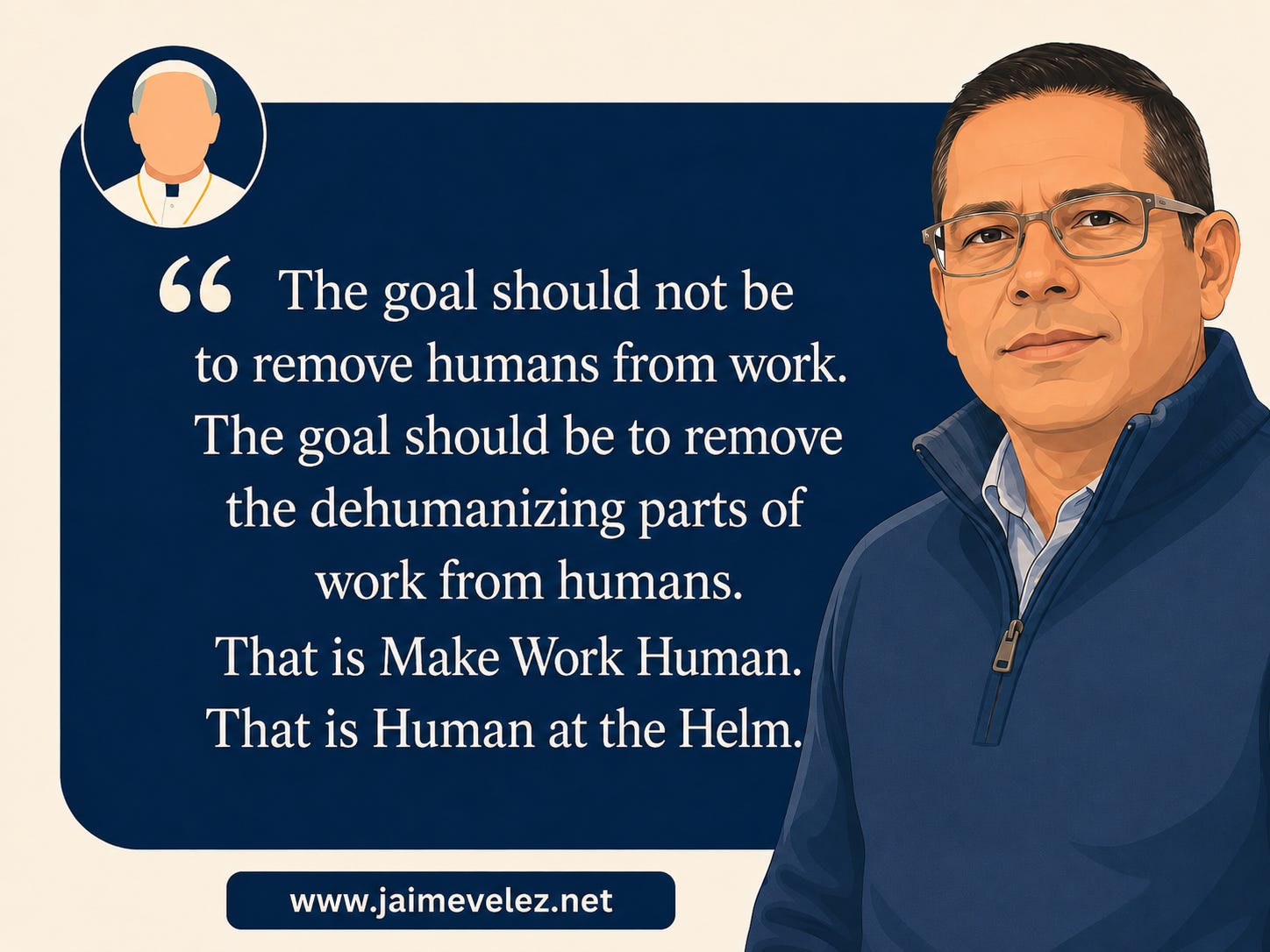
The goal should not be to remove humans from work.
The goal should be to remove the dehumanizing parts of work from humans.
That is Make Work Human.
That is Human at the Helm.
Truth, Freedom, and the Human Soul
Another major theme in Magnifica Humanitas is truth.
This matters because AI does not only affect productivity. It affects reality itself.
Generative AI can create text, images, audio, video, arguments, summaries, and simulations. That power can educate and inspire. It can also distort, manipulate, confuse, and overwhelm.
When everything can be generated, trust becomes more important, not less.
We will need people who can verify.
People who can discern.
People who can ask better questions.
People who can resist manipulation.
People who can protect the difference between what is persuasive and what is true.
This is another reason Human at the Helm matters.
The human role is not simply to operate AI.
The human role is to preserve meaning.
To remember that truth is not just content. It is a moral commitment.
To remember that freedom is not just the ability to click, scroll, prompt, and consume. Freedom is the ability to choose the good without being manipulated by systems designed to capture our attention and shape our desires.
That may sound dramatic, but look around.
The attention economy already trained people to live reactively. AI could make that worse. Or, used wisely, it could help us reclaim focus, clarity, and intentionality.
Again, same technology.
Different helm.
The Future Needs Builders, Not Spectators
One line from the encyclical that stayed with me is the call not to be afraid to get our hands dirty on the construction site of our time. The Pope is essentially saying that we cannot stand back, watch this transformation happen, and hope someone else figures it out.
That is important.
Because right now, many people are watching AI from a distance.
Some are afraid.
Some are excited.
Some are overwhelmed.
Some are pretending it will not affect them.
Some are waiting for their organization to give them permission to care.
But this is not a spectator moment.
This is a builder moment.
We need builders who understand technology.
Builders who understand people.
Builders who understand ethics.
Builders who understand work.
Builders who understand faith, dignity, and responsibility.
Builders who can hold power and humility at the same time.
That is the kind of leadership the AI age requires.
Not hype men.
Not doomers.
Not prompt monkeys.
Not executives chasing shiny objects because everyone else is.
Builders.
Quiet builders, even. (Check out my AI-created Quiet Builder song.)
People willing to ask, “What are we really building here?”
The Real AI Question
The real AI question is not whether machines will become more powerful.
They will.
The real question is whether humans will become more wise.
Will we use AI to deepen dignity or accelerate dehumanization?
Will we build systems of communion or systems of control?
Will we preserve human judgment or outsource it because it feels inconvenient?
Will we make work more human or simply make productivity more relentless?
Will we use AI to serve the common good or to build another Tower of Babel with better branding?
That is why Magnifica Humanitas matters.
It gives spiritual and moral language to what many of us have been sensing.
AI is not just a technology shift. It is a human test.
And the test is not whether we can keep up with the machines.
The test is whether we can remain human while using them.
Final Thought
I do not believe the future belongs to AI.
I believe the future belongs to humans who learn how to lead with AI.
Humans with conscience.
Humans with courage.
Humans with humility.
Humans with discernment.
Humans who know the difference between speed and wisdom.
Humans who refuse to let efficiency become their highest value.
Humans who understand that the person is always more important than the process.
That is the promise of Magnifica Humanitas.
That is the heart of Human at the Helm.
AI may be one of the most powerful tools humanity has ever created.
But tools do not decide what kind of world we build.
We do.
And if we are going to build something worthy of the human person, then we cannot drift into the future asleep at the wheel.
We need our hands on the helm.
Our conscience awake.
Our eyes clear.
Our hearts still human.
Let’s protect our Magnificent Humanity.